Photo Courtesy of Daniela Cirone
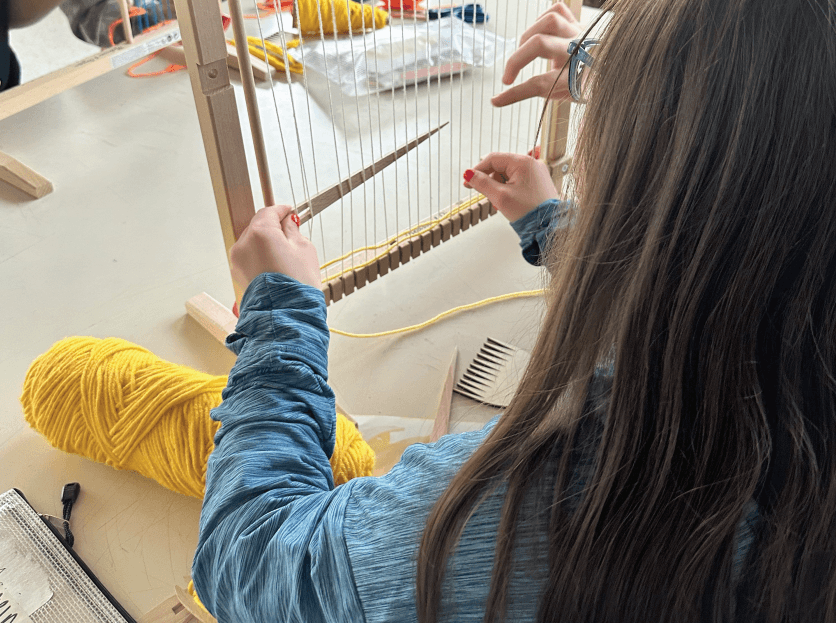
“Threaded Harmony: A Sensory Tapestry,” an Express Grant funded by Naperville Education Foundation (NEF), has brought creative opportunity through weaving to students with special needs at Naperville Central High School.
Daniela Cirone, fine arts teacher at Naperville Central, started teaching the Adapted Art class this year.
“After teaching a semester of Adapted Art I found that textures seemed to be very effective in the class as it’s sensory-based for our students with multiple needs, so I wanted to include as many textures as possible,” Cirone said.
Cirone applied for an Express Grant to purchase materials for the implementation of inclusive weaving lessons for Adapted Art students.
“I was inspired to write this grant because I soon found, starting this class, that there was no fee for the students so there was no supplies able to be purchased so I rely heavily on donations,” Cirone said. “Donations are very nice, and we have a lot of donations, but I found that we had a lot of recycled materials. I thought it would be nice to write a grant for something that wouldn’t typically be donated—the looms.”
The grant-writing process allowed Cirone to develop a strong sense of the deeper meaning behind the weaving lesson.
“I had to dig deep into the lesson and why I wanted to teach it which I thought was good,” Cirone said. “I felt like [the looms] were giving [Adapted Art students] an opportunity to explore a medium that we typically don’t have here in the school.”
After receiving the grant, Cirone bought supplies and implemented a weaving unit in her curriculum that provided students with the opportunity to collaborate, be creative and express their individuality.
“Thank you to the NEF for allowing us to purchase these [looms] so our students in Adapted Art can have the opportunity to work with non-traditional materials,” Cirone said. “The sensory part of the threads and the strings really goes a long way.”


